Why your bank declines an international purchase and how to fix it
The real causes of a card decline on a dollar purchase, why retrying makes it worse, and what to do in each case.

International purchases are switched off
This is the number one cause and the easiest to fix. Many banks issue cards with online purchases outside the country blocked by default, and the toggle sits in the app, under security or limits.
Some issuers enable it only for a window, twenty-four hours for example. If you switched it on days ago and the charge fails again, check whether that permission expired.
The limit or balance does not cover the total
The amount your bank has to authorise is not just the order's: it includes the conversion into your currency and, depending on the country, fees or taxes the issuer itself applies. A tight limit falls short over that gap.
On debit cards there is also often a daily online purchase cap independent of the balance. Having money in the account and still hitting that cap is common.
The issuer flagged the attempt as suspicious
A dollar purchase from a country where you never buy, at a new merchant, for a round amount, matches the pattern anti-fraud systems watch. The issuer would rather decline and have you call.
This is where retrying hurts: each failed attempt confirms the pattern and tightens the block. After two consecutive declines it is better to stop, sort it out with the bank and come back once.
The details do not match the cardholder
The name, billing address or postal code you enter must match what your bank has on record. A minor difference, such as an incomplete surname, is enough for the authorisation to fail.
If you are paying with someone else's card, that is exactly the scenario these checks exist to stop. The sensible route is for the cardholder to pay, or to switch to a method that does not depend on that match.
Final checklist before you send
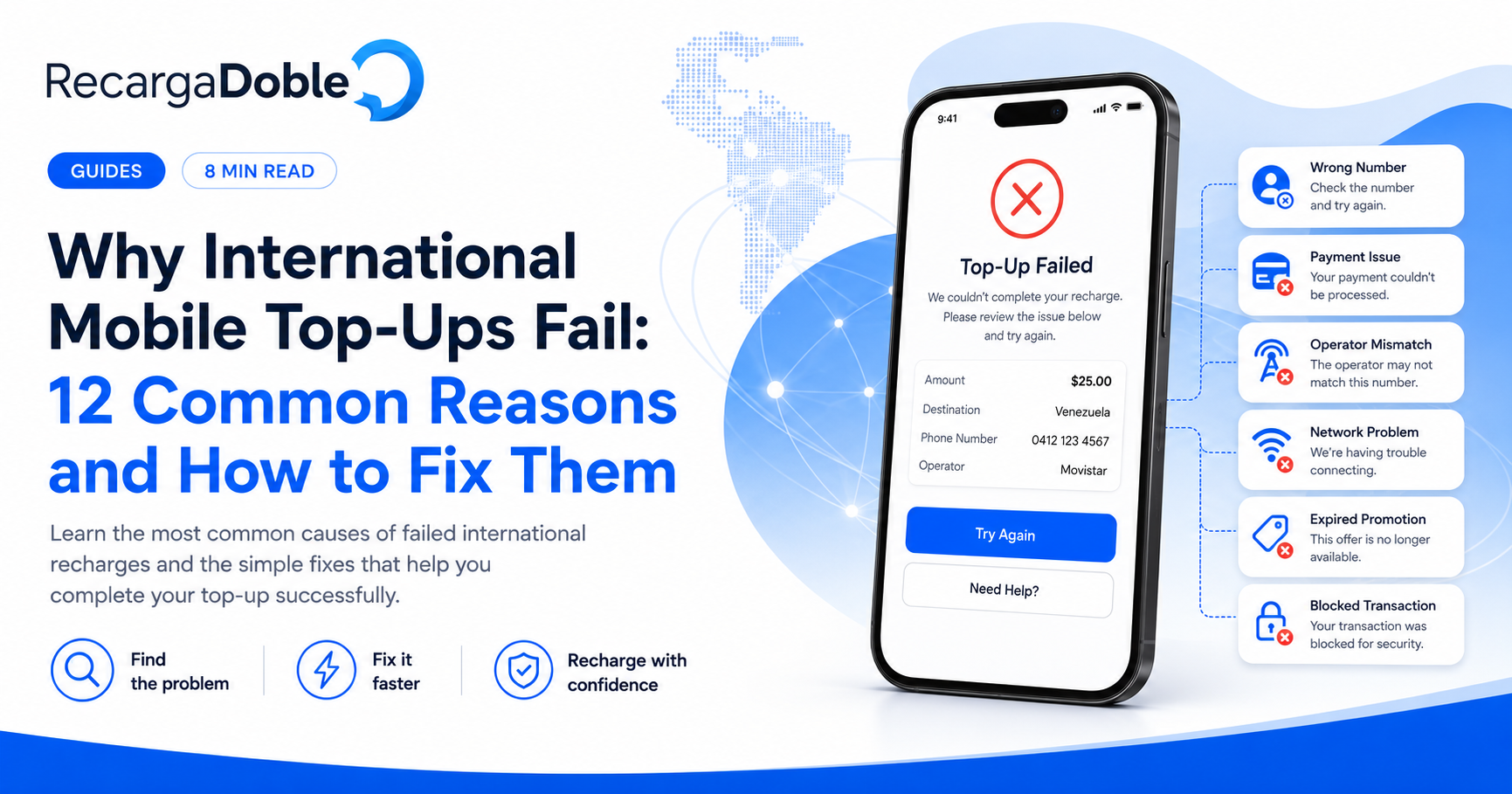
Confirm the recipient number from a current source before paying. A saved contact can be outdated, copied with extra characters, or tied to a SIM the recipient no longer uses.
Review country and carrier together. A correct number with the wrong operator can fail or route incorrectly, especially when a family member has changed lines.
Choose the product for the recipient's next real need: flexible airtime for plan control, data when connectivity is the priority, and promotions only when the rules are clear.
Keep one checkout session open and wait for the final status before retrying. Multiple attempts can create duplicate payments or confusing pending states.
Save the receipt until the recipient confirms the balance or package. The transaction reference is the fastest path for support if the operator takes longer than expected.
Useful next steps
Article FAQs
Was I charged even though the payment was declined?
A decline creates no charge. Sometimes a temporary hold remains on the available balance, which the bank itself releases within days; it is not a charge and does not appear on the final statement.
How many times can I retry?
Technically as many as you want, but going beyond two in a row is unwise. From there the issuer reads the insistence as a fraud signal and the block becomes harder to lift.
What do I tell the bank when I call?
That you want to authorise an online purchase abroad, in dollars, for an approximate amount. With that the agent can lift the block or enable the missing permission.
What if I do not want to call the bank?
You can pay the same order with PayPal or with USDT. Neither goes through your issuer's authorisation, so the decline stops being an obstacle.
About the author

Computer engineer and founder of RecargaDoble.com, writes about international mobile top-ups, mobile operators, telecommunications, and technology, combining his technical expertise with in-depth industry knowledge.
Related guides