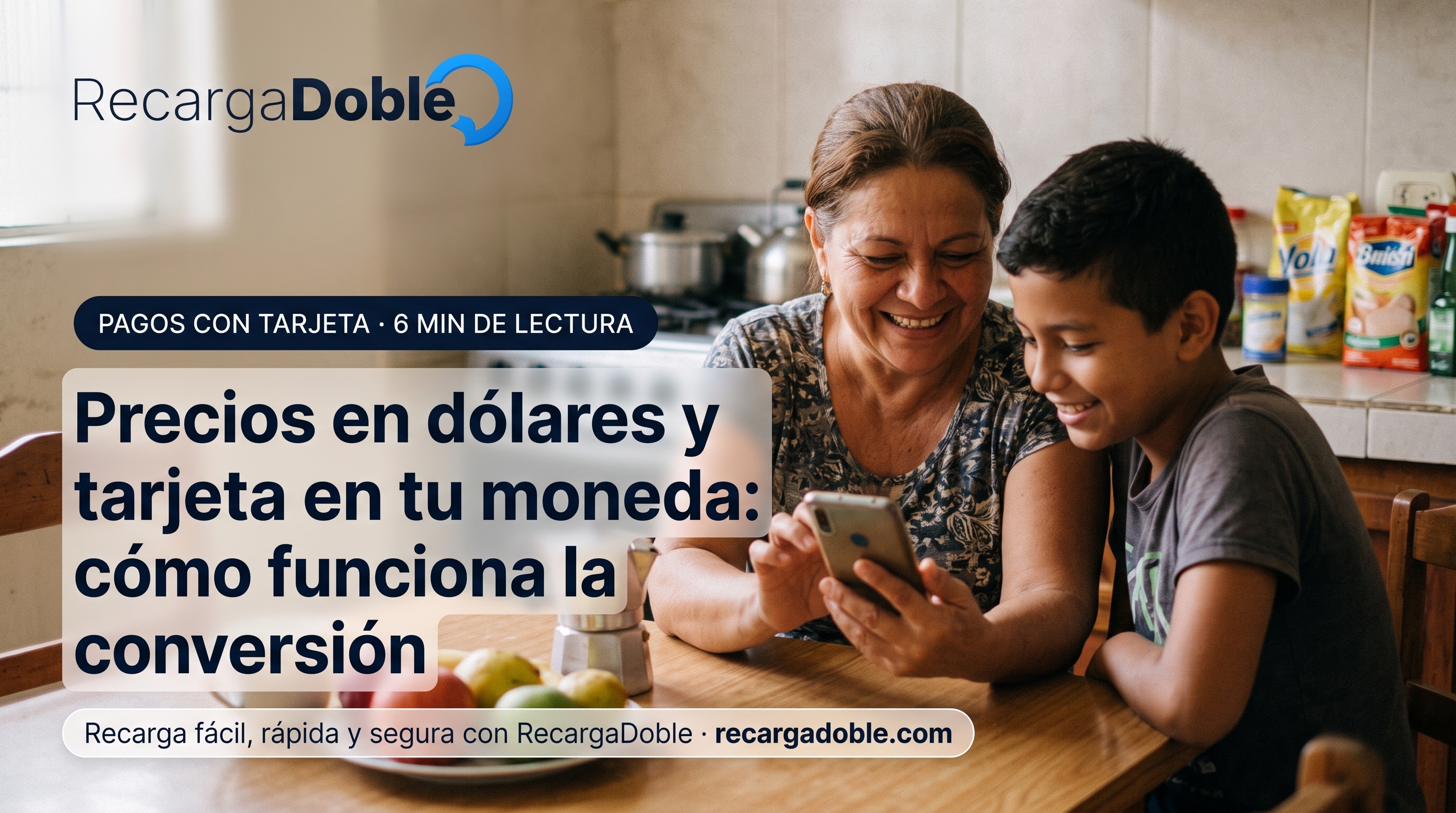
Dollar prices and a card in your currency: how the conversion works
Who converts, at what rate, why the final amount appears days later, and why accepting a charge in your own currency is rarely a good idea.
Your bank does the conversion, not the store
The charge travels in dollars through the card network and reaches your issuer, which converts it into your currency to post it to the account. The store never decides the exchange rate nor knows it in advance.
That is why the dollar total is the solid figure: it is the same for everyone and does not change. What varies from buyer to buyer is what their bank ends up posting in local currency.
Why the exact amount takes time to appear
When you pay, your bank holds an approximate amount against the available balance. The final conversion happens when the transaction settles, usually a day or two later, at that moment's rate.
That is why the app shows one figure at purchase and a slightly different one on the statement. It is not a double charge nor an error: it is the difference between the hold and the settlement.
When you are offered a charge in your own currency
Some payments offer to charge you directly in your local currency instead of dollars. It sounds convenient, but that conversion is done by a payment intermediary, not your bank, and usually applies a wider margin.
The general advice is to leave the charge in dollars and let your issuer convert. It is the same logic as paying abroad with a card: the intermediary's conversion is rarely in your favour.
How to avoid the conversion altogether
There are two routes. One is paying with a card tied to a dollar account, if your bank offers one: the charge lands in the same currency and no exchange rate is involved.
The other is paying with crypto. USDT and USDC are worth a dollar, the order is in dollars, and the amount you send is exactly the order's: no bank converting and no margin to argue about.
Final checklist before you send
Confirm the recipient number from a current source before paying. A saved contact can be outdated, copied with extra characters, or tied to a SIM the recipient no longer uses.
Review country and carrier together. A correct number with the wrong operator can fail or route incorrectly, especially when a family member has changed lines.
Choose the product for the recipient's next real need: flexible airtime for plan control, data when connectivity is the priority, and promotions only when the rules are clear.
Keep one checkout session open and wait for the final status before retrying. Multiple attempts can create duplicate payments or confusing pending states.
Save the receipt until the recipient confirms the balance or package. The transaction reference is the fastest path for support if the operator takes longer than expected.
Useful next steps
Article FAQs
Can I know how much I will be charged in my currency?
Only approximately, by multiplying the dollar total by your bank's rate. The exact figure is set by your issuer at settlement, and some banks show it in the app before the statement closes.
Does the store profit from the conversion?
No. The order is charged in dollars and that is where its part ends; the exchange rate and conversion fees belong to your issuer.
Why is the price not shown in my currency?
Because it would be a made-up price: the real conversion is applied by your bank at its own rate, and showing another figure would create an expectation the statement would not confirm.
Do my country's taxes add to this?
If your country applies taxes or withholdings on international purchases, your issuer adds them at settlement and they appear itemised on the card statement. They are not part of the order total.
About the author

Computer engineer and founder of RecargaDoble.com, writes about international mobile top-ups, mobile operators, telecommunications, and technology, combining his technical expertise with in-depth industry knowledge.
Related guides