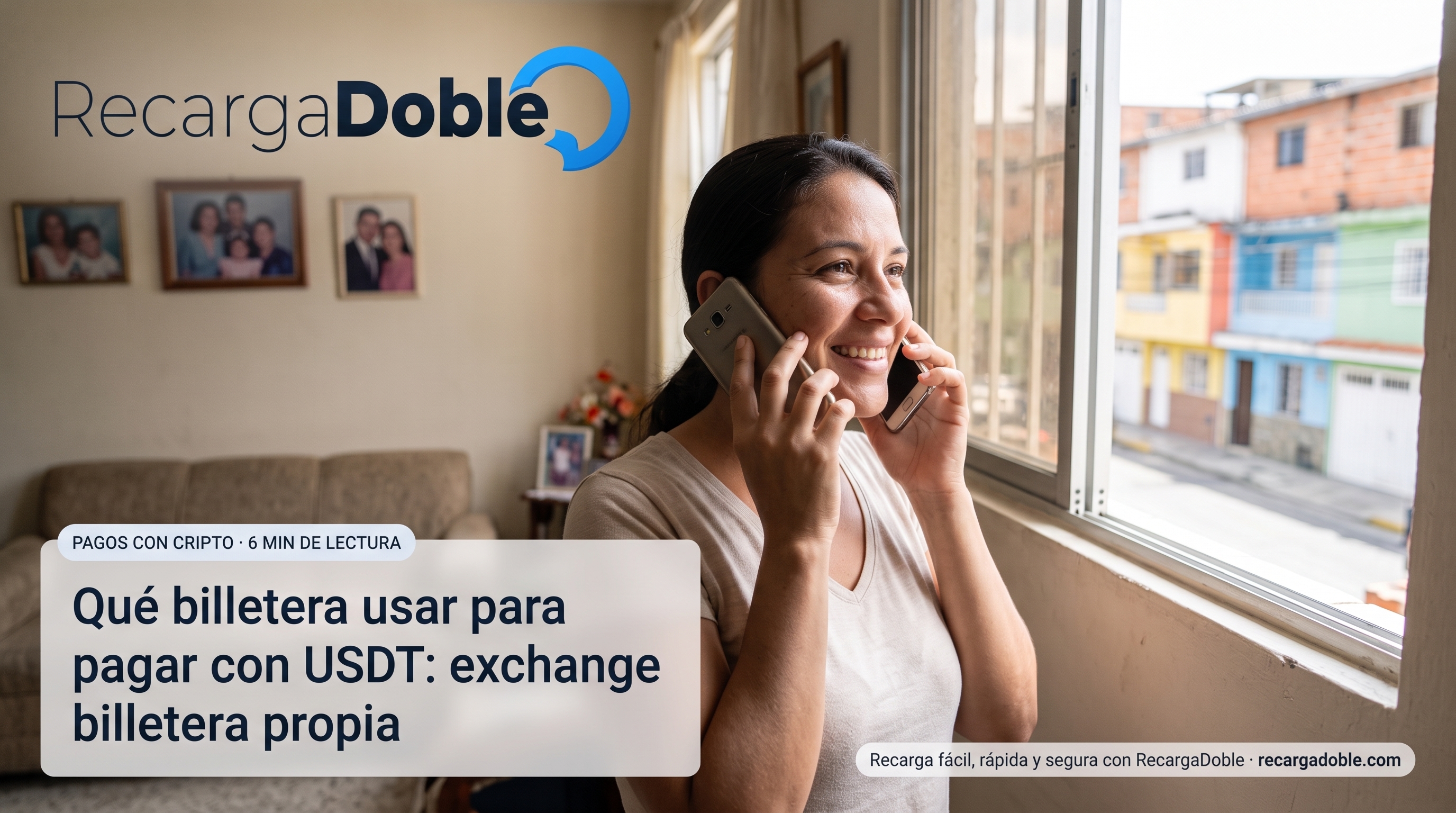
Which wallet to use to pay with USDT: exchange or self-custody
Practical differences between holding your balance on an exchange or in your own wallet when paying, with the upsides and downsides of each.
Balance on an exchange
This is the most common setup in the region, especially if you buy through the peer-to-peer market. The advantage is that buying and sending happen in the same app, with no steps in between.
Three particularities to keep in mind: the withdrawal fee the platform deducts, the security steps the first time you send to a new address, and making sure the balance sits in the account you can withdraw from.
Balance in your own wallet
Here there is no platform withdrawal fee and no verification steps: only the network fee. The send is immediate and depends on nobody approving the operation.
In exchange, the responsibility is entirely yours: if you lose the recovery phrase, no support desk restores the balance. You also need the network's native coin to pay the fee.
The detail that surprises people: the network fee
To send USDT over Tron you need some TRX in the wallet; over BSC, some BNB; over Ethereum, some ETH. The fee is not paid in USDT itself, and a wallet with a balance but no native coin cannot send anything.
On an exchange this goes unnoticed because the fee is deducted from the balance automatically. It is why a first payment from a self-custody wallet sometimes stalls halfway.
What to choose for paying a top-up
For a one-off payment, whatever you already have working. It is not worth moving balance from one place to another right before paying: each move adds a fee and one more moment to pick the wrong network.
If you top up frequently, holding the balance in your own wallet simplifies things: no verifications and no daily withdrawal limits. Just remember to keep a little native coin for fees.
Final checklist before you send
Confirm the recipient number from a current source before paying. A saved contact can be outdated, copied with extra characters, or tied to a SIM the recipient no longer uses.
Review country and carrier together. A correct number with the wrong operator can fail or route incorrectly, especially when a family member has changed lines.
Choose the product for the recipient's next real need: flexible airtime for plan control, data when connectivity is the priority, and promotions only when the rules are clear.
Keep one checkout session open and wait for the final status before retrying. Multiple attempts can create duplicate payments or confusing pending states.
Save the receipt until the recipient confirms the balance or package. The transaction reference is the fastest path for support if the operator takes longer than expected.
Useful next steps
Article FAQs
Do I need to install any app from the site?
No. The payment is an ordinary transfer from wherever your balance is; there is no extension, no wallet connection and no app to download.
Can I send from a relative's wallet?
It works, because what is verified is the amount arriving. Bear in mind any refund is agreed with the order's owner and goes to an address they confirm.
Which wallet is best?
There is no single answer, and be wary of anyone giving one. What matters for paying is that it supports the network your order shows and that you can use it without hesitating.
Does the site store my address?
Incoming transfers are recorded with their chain data, which is public by nature. You are not asked to link a wallet or register an address to pay.
About the author

Computer engineer and founder of RecargaDoble.com, writes about international mobile top-ups, mobile operators, telecommunications, and technology, combining his technical expertise with in-depth industry knowledge.
Related guides